
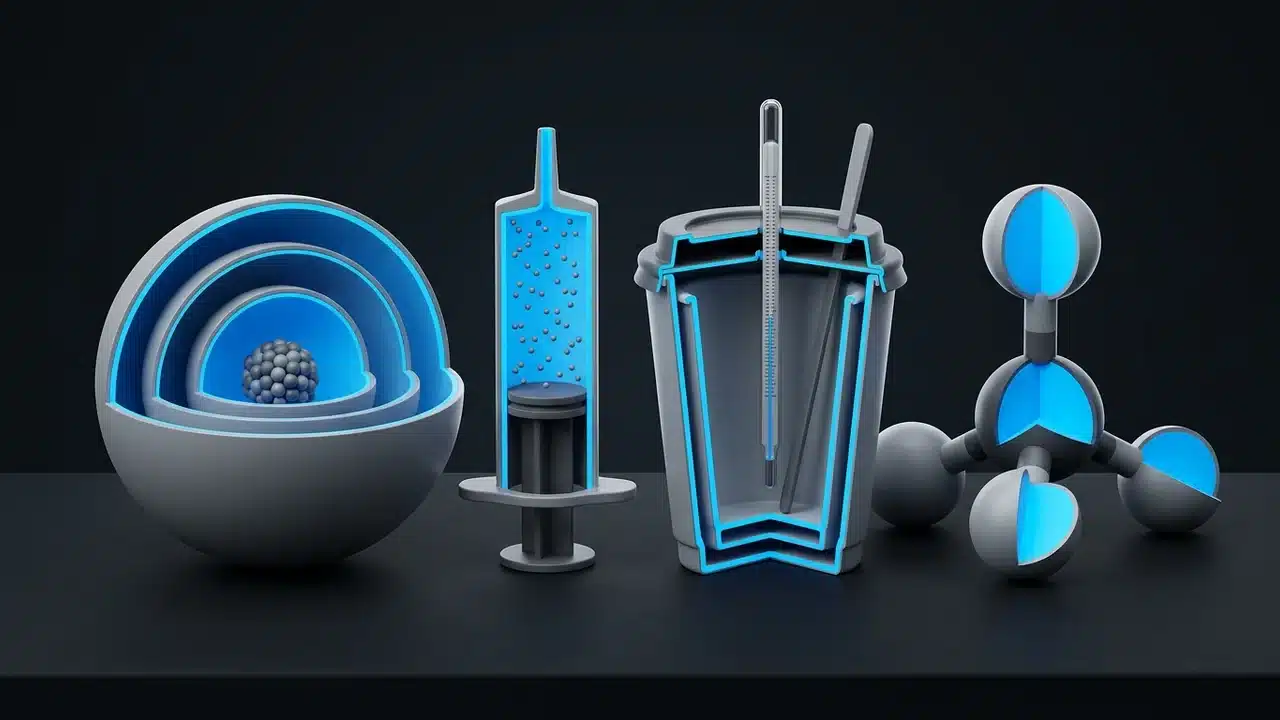
Your professor just announced that the final is an ACS exam, and the first question in your head is probably “what’s even on it?” That’s a fair question. A standardized final can feel like a black box, especially when your class notes cover a semester’s worth of material. The ACS Gen Chem 1 exam is much less mysterious once you see it as a map of topics you’ve already met. So what topics are on the ACS Gen Chem 1 exam?
The ACS Gen Chem 1 exam, often called the first-term general chemistry exam, covers the core of a first-semester course. Expect measurement and significant figures, atoms and periodic trends, nomenclature, stoichiometry, solutions, gases, thermochemistry, quantum theory and electron configurations, and bonding with Lewis structures and VSEPR. Most questions are multiple choice and many involve a short calculation or a concept you have to apply, not just recall. Exact coverage depends on the form your school uses and on the order your course teaches topics. Your professor picks the exam form and sets the time limit, so your syllabus is the final word.
What Is the ACS Gen Chem 1 Exam, Exactly?
It’s a standardized final written by a committee of chemistry educators and published by the ACS Exams Institute, which is part of the American Chemical Society’s Division of Chemical Education and is run with the University of Wisconsin-Milwaukee. The ACS Exams Institute’s homepage lists a General Chemistry First-Term exam along with its other general chemistry exams.


Many schools use these exams because they’re nationally normed. That means your score can be compared with students at other colleges who took the same form. Most ACS exams are multiple choice, and the length and time limit vary by exam and by form. Scoring can differ by form, too. The Institute notes that its First-Term 2025 exam can include partial credit. If you’re curious how raw scores turn into percentiles and grades, this article on how the ACS exam is graded walks through it.
A quick note on the sample questions below. They’re my own simple examples, written to show the type of thinking each topic asks for. They are not taken from any ACS exam, and they don’t paraphrase one. Actual exam questions are often more layered, so treat these as warm-ups.
The Topic Map for the ACS Gen Chem 1 Exam
Here’s each major topic, the kind of question to expect, and a quick sample to test yourself. Each answer is in parentheses right after the question. Cover the answer with your thumb and actually try each one. A wrong answer here costs you nothing, and it tells you exactly where to spend your study time.
Measurement, Units and Significant Figures
Expect questions on unit conversions, density, scientific notation and how many sig figs belong in a calculated answer. These look easy, which is why they cost people points.
Try it: How should the answer to (12.0 × 3.456) ÷ 1.2 be reported? (Answer: 35. The value 1.2 has only two significant figures, so 34.56 rounds to 35.)
Atoms, Isotopes and Periodic Trends
Expect questions on protons, neutrons and electrons in atoms and ions, average atomic mass, and trends like atomic radius, ionization energy and electronegativity across a period and down a group.
Try it: Which atom has the largest radius: Na, Mg, Cl or K? (Answer: K. Radius increases going down a group and decreases going left to right across a period.)
Nomenclature and Formulas
Expect to go between names and formulas for ionic compounds, molecular compounds, acids and common polyatomic ions. You can’t do the rest of the exam if you can’t read the formulas, so this skill hides inside a lot of other questions.
Try it: What is the formula of iron(III) sulfate? (Answer: Fe2(SO4)3. Two Fe3+ ions balance three SO42− ions.)
Stoichiometry and Reactions
Expect mole conversions, balanced equations, limiting reactant, percent yield, empirical formulas and reaction types like precipitation, acid-base and simple redox. This is usually one of the heaviest areas on any first-semester final.
Try it: In CH4 + 2 O2 → CO2 + 2 H2O, how many moles of O2 are needed to burn 2.0 mol of CH4? (Answer: 4.0 mol. The mole ratio is 2 O2 to 1 CH4.)
Solutions and Solution Stoichiometry
Expect molarity, dilution, titration math and net ionic equations. Many questions combine molarity with a reaction, so you’re doing stoichiometry with liters instead of grams.
Try it: What is the molarity of a solution made by dissolving 5.85 g of NaCl in enough water to make 250.0 mL? (Answer: 0.400 M. 5.85 g ÷ 58.44 g/mol = 0.1001 mol, and 0.1001 mol ÷ 0.2500 L = 0.400 M.)
Gases
Expect the ideal gas law, combined gas law, partial pressures, gas density and some kinetic molecular theory. Watch your units, especially temperature in kelvin.
Try it: What volume does 0.500 mol of an ideal gas occupy at 273 K and 1.00 atm? (Answer: about 11.2 L, using V = nRT/P with R = 0.08206 L·atm/(mol·K).)
The Second Half of the Map: Energy, Electrons and Bonds
The last three topics are where the course shifts from counting particles to explaining why they behave the way they do. They also tend to show up in combination with earlier topics, so a bonding question might quietly require a nomenclature step first.
Thermochemistry
Expect heat and temperature change (q = mcΔT), calorimetry, enthalpy of reaction, Hess’s law and enthalpies of formation. Sign conventions are where most mistakes happen here.
Try it: How much heat does it take to warm 50.0 g of water from 20.0 °C to 30.0 °C? Water’s specific heat is 4.184 J/(g·°C). (Answer: 2.09 kJ. 50.0 × 4.184 × 10.0 = 2,092 J.)
Quantum Theory and Electron Configuration
Expect light and energy (wavelength, frequency, photon energy), quantum numbers, orbital diagrams, electron configurations and how configuration explains periodic trends.
Try it: How many unpaired electrons does a ground-state nitrogen atom have? (Answer: 3. The 2p subshell holds three electrons, one in each orbital, following Hund’s rule.)
Bonding, Lewis Structures and VSEPR
Expect Lewis structures, formal charge, resonance, molecular shape, bond angles, polarity and sometimes hybridization. Shape questions are very common because they test several ideas at once.
Try it: What is the molecular shape of NH3? (Answer: trigonal pyramidal. Nitrogen has three bonding pairs and one lone pair.)
Which ACS Gen Chem 1 Questions Do Students Miss Most?
There’s no public list of most-missed ACS questions that I can point you to. But a few areas trip up gen chem students again and again, and you can see why when you look at what they ask.
- Stoichiometry with a twist. A limiting reactant buried in a word problem, or a molarity step added on, is where careful students lose points.
- Thermochemistry signs. Exothermic means ΔH is negative. Mixing up the sign of q for the system versus the surroundings is very common.
- Lewis structures for ions and molecules with exceptions to the octet rule. Count electrons slowly.
- Periodic trend exceptions. Ionization energy has small dips (for example, from N to O) that are explained by electron configuration.
- Sig figs and units. Simple, but easy to rush on a timed test.
Notice a pattern? These are mostly multi-step questions. The exam rewards students who can chain ideas together, not just students who memorized definitions.
What Usually Isn’t on the First-Term Exam?
Topics that build on the whole first semester usually wait for the second term. That generally means kinetics, chemical equilibrium, acid-base equilibrium and pH calculations with Ka, solubility equilibrium, entropy and Gibbs free energy, electrochemistry and nuclear chemistry.
That doesn’t mean you’ll never see the words “acid” or “equilibrium” on a first-term final. You might be asked to identify a strong acid, write a neutralization reaction or recognize a double arrow. What you usually won’t see is the heavier math those topics bring in the second semester.
The big takeaway: Gen Chem 2 reuses nearly everything on this list. Stoichiometry, gas laws and Lewis structures come right back. So the time you spend mastering the first-term topics pays off twice.
Does Every School Cover the Same Gen Chem 1 Topics?
No. Course order varies a lot. Some programs teach atoms first and stoichiometry later. Others start with stoichiometry. Some include intermolecular forces, phase changes or an intro to solutions properties in the first semester, while others push those into Gen Chem 2.
Your professor also picks which exam form to give, and some instructors use only part of a standardized exam or combine it with their own questions. Because of all that, the best source of truth is your syllabus and your professor. Ask directly: “Which topics from this semester will the final emphasize?” Most instructors are happy to answer that question.
If your course used a different order than the map above, don’t panic. The topics are the same building blocks. They’re just stacked differently.
How Should You Study These Topics?
Study by working problems, not by rereading notes. Reading feels productive, but chemistry exams test whether you can do the steps, and the only way to practice doing the steps is to do them.
- Rate each topic above as strong, okay or weak. Start with your weakest.
- Work a small set of problems from each topic without looking at your notes, then check.
- Mix topics together in later sessions, the way the real exam does.
- Take at least one timed, full-length practice test so the pacing isn’t a surprise.
The ACS Exams Institute sells an official study guide for general chemistry, and your campus library or tutoring center may have a copy to borrow. Your textbook’s end-of-chapter problems are also a great free resource.
To test the whole topic map in one sitting, set a timer and try our Gen Chem 1 ACS-style practice exam, which uses the same multiple-choice format and gives each question its own video walkthrough. (ChemExams isn’t affiliated with the American Chemical Society, and the questions are our own.)
Your Gen Chem 1 Final, One Topic at a Time
So what’s on the ACS Gen Chem 1 exam? Measurement, atoms and periodic trends, nomenclature, stoichiometry, solutions, gases, thermochemistry, electron structure and bonding, with the exact mix depending on your school. That’s the whole first semester, which sounds like a lot, until you realize each topic is a skill you can practice on its own.
Pick one weak topic from the list and give it your next two study sessions.
Each topic you lock down makes the next one easier.