
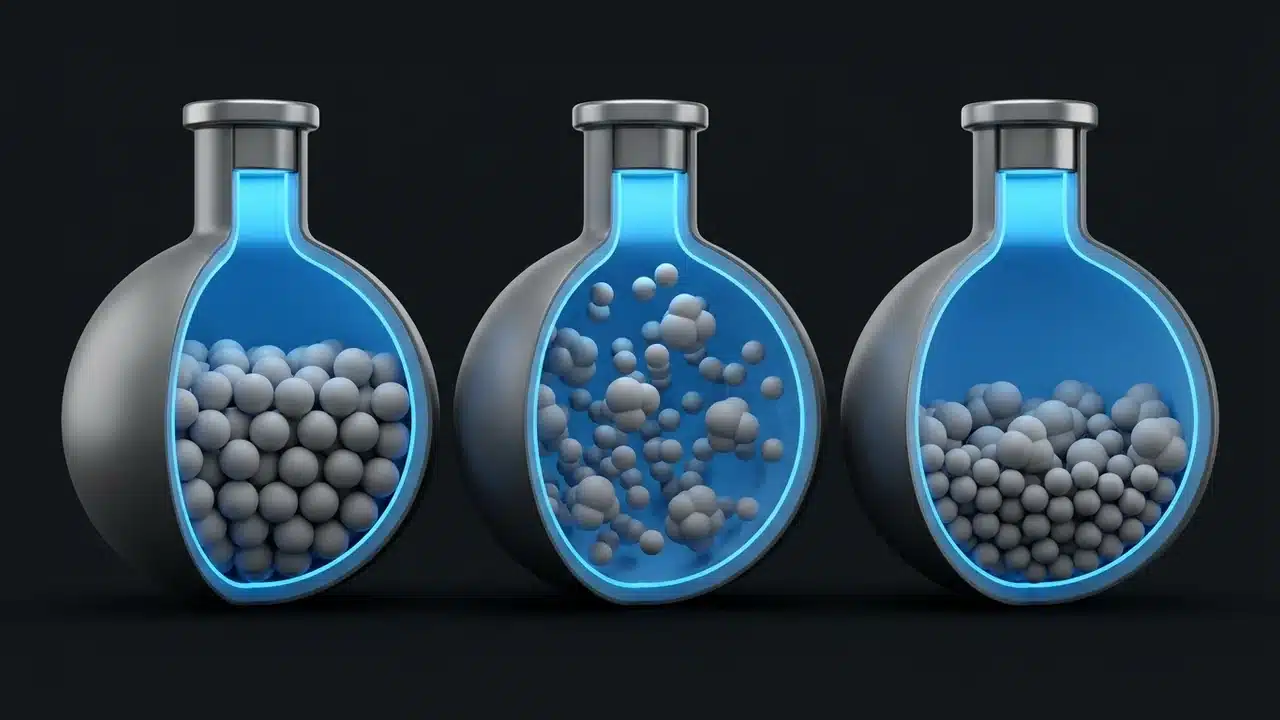
Equilibrium is usually the first Gen Chem 2 topic where the math stops being plug-and-chug. You get a starting concentration, an equilibrium constant, and a question about what’s left at the end, with no obvious formula to use. That’s exactly the gap ICE tables fill. They turn a word problem into a small grid you can fill in one row at a time. How do you set up and solve an ICE table, and when can you take the shortcut?
An ICE table organizes an equilibrium problem into three rows: Initial concentrations, the Change in each concentration (written with x and the reaction’s coefficients), and the Equilibrium concentrations, which are Initial plus Change. You plug the Equilibrium row into the equilibrium constant expression and solve for x. If K is small compared with the starting concentration, you can often assume x is tiny and drop it from subtraction terms, which is called the small-x approximation. You then check that x is less than 5 percent of the starting concentration. If it isn’t, you solve the full equation with the quadratic formula instead.
What Do ICE Tables Actually Track?
ICE tables track how concentrations change as a reaction moves from where it starts to where it settles. ICE stands for Initial, Change, Equilibrium. Each column is one substance, and each row is one moment in the story.


- Initial is what you put in the flask, usually in mol/L (M).
- Change is how much each concentration goes up or down. Reactants lose, products gain, and the amounts follow the coefficients.
- Equilibrium is Initial + Change. These are the only numbers that go into K.
Think of it like a bank statement. You have a starting balance, a list of deposits and withdrawals, and an ending balance. Nobody would plug the starting balance into a formula that needs the ending one. K works the same way. It only cares about the ending balance.
Two quick rules before we start. Pure solids and pure liquids (like water as a solvent) don’t appear in K, so they don’t get a column. And the coefficients become both the multipliers on x and the exponents in K.
How Do You Set Up an ICE Table?
You set up an ICE table in five steps.
- Write the balanced equation and the K expression.
- Fill in the Initial row with the given concentrations. Anything not mentioned starts at zero.
- Decide which way the reaction shifts. If only reactants are present, it must go forward. If both sides are present, compare Q to K.
- Fill in the Change row using x times each coefficient, with minus signs on the side being used up.
- Add down the columns to get the Equilibrium row, plug into K, and solve for x.
Step 3 is the one people forget. The reaction quotient Q has the same form as K but uses the current concentrations. If Q is less than K, the reaction moves forward toward products. If Q is greater than K, it moves backward. OpenStax has a clear section on comparing Q and K to predict the direction of shift if that part feels shaky.
Worked Example 1: A Kc Problem
Problem: Hydrogen and iodine react to form hydrogen iodide. At a certain temperature, Kc = 64.0. If 1.00 M H2 and 1.00 M I2 are placed in a sealed container with no HI, what are the equilibrium concentrations?
H2(g) + I2(g) ⇌ 2 HI(g)
Kc = [HI]2 / ([H2][I2])
No HI is present at the start, so the reaction must go forward. The table looks like this:
| H2 | I2 | 2 HI | |
|---|---|---|---|
| Initial (M) | 1.00 | 1.00 | 0 |
| Change (M) | −x | −x | +2x |
| Equilibrium (M) | 1.00 − x | 1.00 − x | 2x |
Notice the 2x for HI. The coefficient of 2 means 2 mol of HI forms for every 1 mol of H2 (and of I2) used up.
Now plug in:
64.0 = (2x)2 / (1.00 − x)2
This one has a nice trick. Both sides are perfect squares, so take the square root of each side:
8.00 = 2x / (1.00 − x)
8.00 − 8.00x = 2x, so 8.00 = 10.0x, and x = 0.800.
The equilibrium concentrations are [H2] = [I2] = 1.00 − 0.800 = 0.20 M, and [HI] = 2(0.800) = 1.60 M.
Always check by plugging back in: (1.60)2 / (0.20 × 0.20) = 2.56 / 0.040 = 64. It works. Notice we could not use the small-x shortcut here. K is large, so x turned out to be most of the starting amount.
Worked Example 2: A Weak Acid Ka Problem
Weak acid problems are the most common place you’ll use ICE tables. A weak acid only partly ionizes, and Ka tells you how much.
Problem: Find the pH of 0.10 M acetic acid. Use Ka = 1.8 × 10⁻⁵, a typical textbook value.
CH3COOH(aq) + H2O(l) ⇌ H3O+(aq) + CH3COO−(aq)
Water is the solvent, so it gets no column.
| CH3COOH | H3O+ | CH3COO− | |
|---|---|---|---|
| Initial (M) | 0.10 | ≈ 0 | 0 |
| Change (M) | −x | +x | +x |
| Equilibrium (M) | 0.10 − x | x | x |
(The tiny amount of H3O+ from water itself is too small to matter here, so we treat it as zero.)
Ka = x2 / (0.10 − x) = 1.8 × 10⁻⁵
Ka is very small, so only a little acid ionizes. That means x should be tiny compared with 0.10, and 0.10 − x is basically 0.10. This is the small-x approximation:
x2 / 0.10 = 1.8 × 10⁻⁵, so x2 = 1.8 × 10⁻⁶, and x = 1.34 × 10⁻³ M.
Now check whether the shortcut was fair (more on this rule below): (1.34 × 10⁻³ ÷ 0.10) × 100% = 1.3%. That’s under 5 percent, so the approximation holds.
Since x = [H3O+], pH = −log(1.34 × 10⁻³) = 2.87.
When Does the Small-x Approximation Work?
The small-x approximation works when x ends up less than 5 percent of the initial concentration you subtracted it from. This is often called the 5 percent rule. If x is that small, dropping it barely changes the answer, usually less than the uncertainty in the data.
You can’t know x before you solve, so the routine is always the same: assume, solve, then check. A quick rule of thumb many instructors teach is that the shortcut usually works when the initial concentration divided by K is a few hundred or more. Treat that as a hint, not a replacement for the check.
Here’s the habit to build: never use the small-x shortcut without writing the percent check right after it. On free-response exams, the check is often part of the expected work.
Some professors use a different cutoff or want the quadratic every time. Follow your own instructor’s rule on graded work.
Worked Example 3: When You Need the Quadratic
Problem: A weak acid HA has Ka = 1.0 × 10⁻³. Find the pH of a 0.010 M solution.
The ICE table looks just like the acetic acid one, with 0.010 M as the starting concentration. That gives:
Ka = x2 / (0.010 − x) = 1.0 × 10⁻³
Try the shortcut first. x2 / 0.010 = 1.0 × 10⁻³ gives x2 = 1.0 × 10⁻⁵ and x = 3.16 × 10⁻³ M. The check: 3.16 × 10⁻³ ÷ 0.010 = 32%. That’s way over 5 percent, so the shortcut fails.
Solve it fully. Multiply out the equation:
x2 = (1.0 × 10⁻³)(0.010 − x) = 1.0 × 10⁻⁵ − (1.0 × 10−3)x
x2 + (1.0 × 10⁻³)x − 1.0 × 10−5 = 0
Use the quadratic formula with a = 1, b = 1.0 × 10⁻³, c = −1.0 × 10⁻⁵:
x = [−b + √(b2 − 4ac)] / 2a = [−0.0010 + √(0.0000010 + 0.000040)] / 2 = (−0.0010 + 0.006403) / 2 = 2.70 × 10⁻³ M
Keep only the positive root. A negative concentration makes no physical sense.
pH = −log(2.70 × 10⁻³) = 2.57
Compare that with the shortcut answer, which would have given a pH of 2.50. The difference looks small, but on a multiple-choice exam, a wrong-but-close answer is usually sitting right there as a distractor.
Where ICE Table Setups Go Wrong
- Plugging Initial values into K instead of Equilibrium values.
- Forgetting coefficients in the Change row (writing +x for HI instead of +2x).
- Forgetting coefficients as exponents in K.
- Giving water or a solid its own column.
- Using moles instead of molarity. If the problem gives moles and a volume, divide first.
- Skipping the 5 percent check, or keeping the negative root of a quadratic.
Make ICE Tables Your Default Move
ICE tables work because they slow you down in the right places. Initial, Change, Equilibrium, then K. Use the small-x approximation when K is small, check it against the 5 percent rule every time, and switch to the quadratic when the check fails. That covers most Kc, Ka and Kb problems in a Gen Chem 2 course, and the same grid shows up again with buffers and solubility.
If equilibrium is the unit that made you wonder whether gen chem 2 is harder than gen chem 1, you’re in good company, and practice is what closes the gap.
Our Gen Chem 2 practice exam, built in the style of the ACS final, includes equilibrium questions like these alongside the rest of the second semester.
Start by redrawing the three tables in this article from memory, then try them with new numbers.