
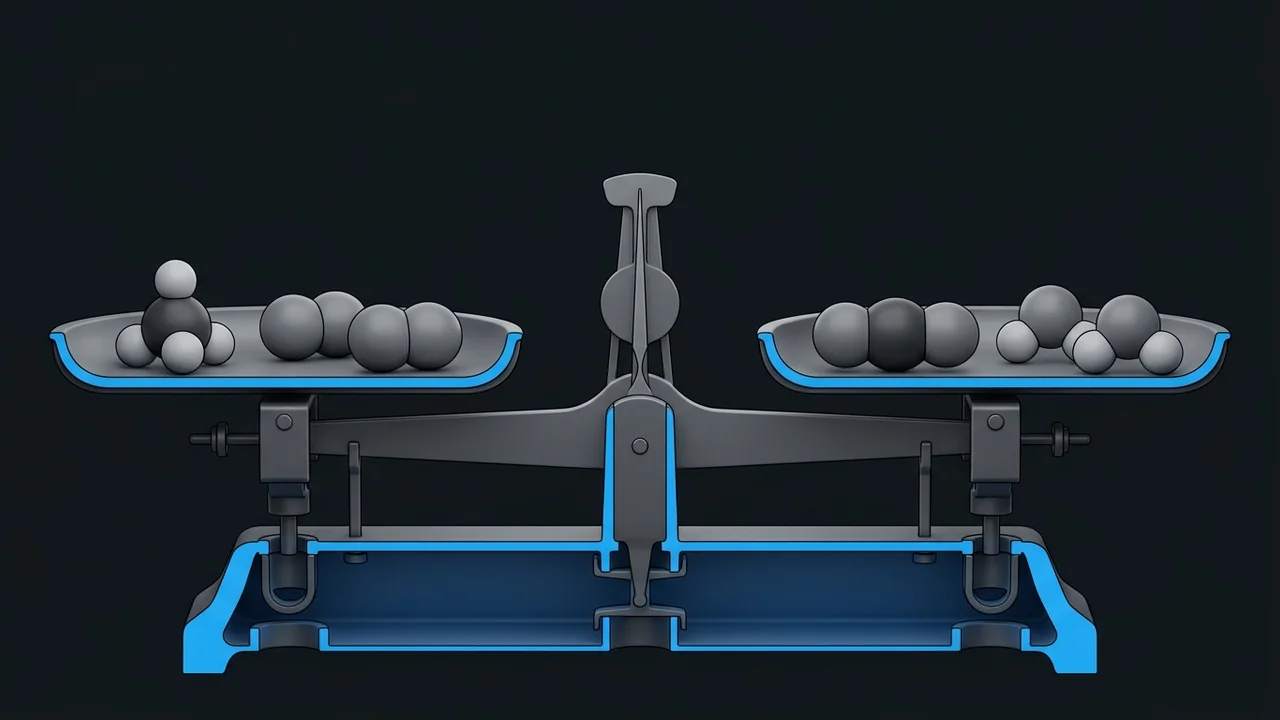
Balancing equations can feel like guessing. You change one number, something else breaks, and ten minutes later the page is full of crossed-out coefficients. It doesn’t have to work that way. Knowing how to balance chemical equations is mostly about doing things in a smart order, and that order is the same almost every time. How do you balance chemical equations step by step, without the guesswork?
To balance a chemical equation, count the atoms of each element on both sides, then add coefficients (never change subscripts) until every element matches. Balance metals first, then nonmetals other than hydrogen and oxygen, and save H and O for last because they usually show up in several compounds. If a polyatomic ion like sulfate or phosphate appears unchanged on both sides, treat it as one unit instead of splitting it into atoms. If you end up needing a fraction, multiply every coefficient by the denominator to clear it. Finish by recounting every atom in a small table so you know the equation is truly balanced.
Why Do Chemical Equations Need to Be Balanced?
Equations need to be balanced because atoms are not created or destroyed in a chemical reaction. This is the law of conservation of mass. The atoms just rearrange into new partners, so the number of each kind of atom on the left must equal the number on the right.


Picture it this way. Imagine taking apart a LEGO car and building a LEGO house with the same bricks. The house looks totally different, but if you started with 12 red bricks, you still have 12 red bricks. A balanced equation is the brick inventory for a reaction.
Balancing also matters later. The coefficients become mole ratios, and those ratios drive every calculation in stoichiometry. A wrong coefficient early means a wrong answer at the end, even if the rest of the math is perfect.
The Two Numbers: Coefficients vs. Subscripts
A coefficient is the big number in front of a formula. A subscript is the small number inside a formula. You may change coefficients. You may never change subscripts.
Why? Subscripts define what the substance is. H2O is water. H2O2 is hydrogen peroxide, a completely different chemical. If you change a subscript to make the atoms work out, you’ve balanced an equation for a reaction that isn’t happening. OpenStax explains this rule clearly in its section on writing and balancing chemical equations, which is a free and reliable place to get extra practice.
One rule to remember: a coefficient multiplies everything in the formula after it. The 3 in 3 H2O means 6 hydrogen atoms and 3 oxygen atoms.
How to Balance Chemical Equations: The Method
Use these steps in this order. The order is what keeps you from going in circles.
- Write the correct formulas for every reactant and product. Don’t touch them after this.
- Make a quick atom count for each side.
- Balance metals first.
- Balance nonmetals other than H and O next.
- Treat polyatomic ions that stay intact as single units.
- Balance hydrogen, then oxygen, last.
- Clear any fractions by multiplying everything by the denominator.
- Recount every atom and make sure the coefficients are in the lowest whole-number ratio.
Why leave H and O for last? Oxygen in particular tends to appear in almost every compound in the equation. If you balance it early, fixing anything else will knock it out of balance again. Once everything else is locked in, oxygen is often the only thing left to adjust, and often it sits alone as O2, which is easy to change.
Worked Example 1: A Combustion Reaction
Combustion reactions are the classic practice problem. A hydrocarbon burns in oxygen and makes carbon dioxide and water. Let’s balance the burning of propane.
Unbalanced: C3H8 + O2 → CO2 + H2O
Carbon first. There are 3 carbons on the left and 1 on the right, so put a 3 in front of CO2.
C3H8 + O2 → 3 CO2 + H2O
Hydrogen next. There are 8 hydrogens on the left and 2 on the right. Put a 4 in front of H2O to get 8.
C3H8 + O2 → 3 CO2 + 4 H2O
Oxygen last. Count the right side: 3 CO2 has 6 oxygen atoms and 4 H2O has 4, for 10 total. Oxygen comes as O2 on the left, so you need 5 O2.
Balanced: C3H8 + 5 O2 → 3 CO2 + 4 H2O
Notice how easy the oxygen step was because we waited. Once carbon and hydrogen were set, there was only one blank to fill.
Worked Example 2: Double Replacement With Polyatomic Ions
In a double replacement reaction, two ionic compounds trade partners. These look scary because the formulas are big, but polyatomic ions make them easier if you keep the ions in one piece.
Unbalanced: Ca(NO3)2 + Na3PO4 → Ca3(PO4)2 + NaNO3
The nitrate ion (NO3−) and the phosphate ion (PO43−) both show up unchanged on each side. So instead of counting nitrogen, phosphorus and oxygen atoms separately, count whole nitrate and phosphate units.
Calcium first (a metal). The right side has 3 Ca, so put a 3 in front of Ca(NO3)2.
3 Ca(NO3)2 + Na3PO4 → Ca3(PO4)2 + NaNO3
Phosphate as a unit. The right side has 2 phosphate units, so put a 2 in front of Na3PO4.
3 Ca(NO3)2 + 2 Na3PO4 → Ca3(PO4)2 + NaNO3
Sodium. Now the left has 2 × 3 = 6 sodium atoms. Put a 6 in front of NaNO3.
Balanced: 3 Ca(NO3)2 + 2 Na3PO4 → Ca3(PO4)2 + 6 NaNO3
Nitrate check. Left: 3 × 2 = 6 nitrate units. Right: 6 nitrate units. Done, and we never counted a single oxygen atom on its own.
Worked Example 3: Clearing Fractions
Sometimes the only way to balance oxygen is with a half. That’s fine as a middle step. Let’s burn ethane.
Unbalanced: C2H6 + O2 → CO2 + H2O
Carbon. 2 on the left, so 2 CO2.
Hydrogen. 6 on the left, so 3 H2O.
Oxygen. The right side now has 2 × 2 = 4 oxygen atoms in CO2 plus 3 in H2O, for 7 total. To get 7 oxygen atoms from O2, you would need 7/2 O2.
C2H6 + 7/2 O2 → 2 CO2 + 3 H2O
Clear the fraction. Multiply every coefficient by 2.
Balanced: 2 C2H6 + 7 O2 → 4 CO2 + 6 H2O
Some instructors accept the fraction form for certain uses, like thermochemistry, where a reaction is written per mole of one substance. For a standard balancing question, though, whole numbers are expected. Ask your professor if you aren’t sure which they want.
The Atom-Count Check Table
The final step is the one people skip, and it’s the one that catches mistakes. Make a small table and count each element on each side. Here’s the check for the ethane equation, 2 C2H6 + 7 O2 → 4 CO2 + 6 H2O.
| Element | Left side | Right side | Balanced? |
|---|---|---|---|
| C | 2 × 2 = 4 | 4 × 1 = 4 | Yes |
| H | 2 × 6 = 12 | 6 × 2 = 12 | Yes |
| O | 7 × 2 = 14 | (4 × 2) + (6 × 1) = 14 | Yes |
Also check that the coefficients can’t be divided by a common number. For example, 4, 10, 6 and 8 should become 2, 5, 3 and 4. An equation can be balanced and still not be in lowest terms.
Where Balancing Usually Goes Wrong
- Changing a subscript to make the numbers work. This changes the chemical.
- Forgetting that a coefficient multiplies the whole formula, including atoms inside parentheses. 3 Ca(NO3)2 has 6 nitrogen atoms.
- Writing diatomic elements as single atoms. Oxygen gas is O2, not O. The same goes for H2, N2, F2, Cl2, Br2 and I2.
- Splitting a polyatomic ion that stays intact, which turns a quick problem into a long one.
- Skipping the final count.
What Comes Later: Redox Equations
Some reactions involve electrons moving from one substance to another. These are oxidation-reduction (redox) reactions, and some of them, especially in acidic or basic solution, can’t be balanced easily by inspection. For those, you’ll learn the half-reaction method, where you balance atoms and electrons in each half separately and then combine them. Most students see this near the end of Gen Chem 1 or in Gen Chem 2, depending on the course. For now, the inspection method in this article will handle most of what you meet in the first part of the course.
Balancing Gets Easy When You Follow the Order
Now you know how to balance chemical equations without guessing: metals, then other nonmetals, then hydrogen and oxygen last, with polyatomic ions kept whole and fractions cleared at the end. Then you check every atom in a table. The order is the whole trick.
Balanced equations are also the first step for every mole calculation that follows, so once this feels solid, move on to learning how to do stoichiometry. Balancing rarely appears alone on a final, and our Gen Chem 1 practice exam mixes it with the rest of the semester in the ACS final’s multiple-choice style.
Pick five combustion reactions from your textbook and balance them before your next class, table and all. By the fifth one, you won’t need the list anymore.