
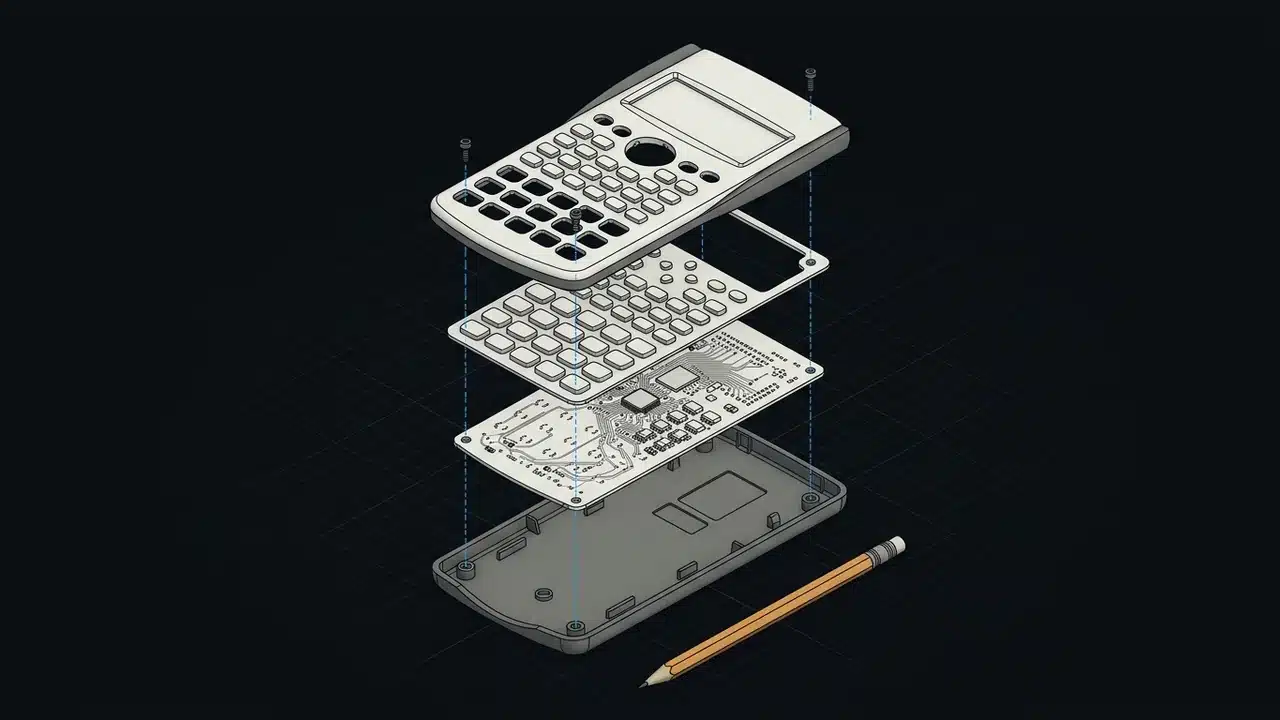
The course page lists “calculator required” and nothing else. Do you need the expensive graphing one your roommate has? Will it even be allowed on the final? Picking the best calculator for chemistry is a small decision, but the wrong pick can get you turned away at the exam door or slow you down when every minute counts. What is the best calculator for chemistry class, and what will your exam allow?
For most college chemistry classes, the best calculator is a basic, non-programmable scientific calculator that you already know how to use. It needs an EE or EXP key for scientific notation, log and ln keys, 10x and ex, and parentheses. Graphing and programmable calculators can do more, but many chemistry instructors ban them on exams because they can store notes. Calculator rules are set by your instructor or school, so check your syllabus before you buy. A cheap scientific model you’ve practiced with beats a fancy one you haven’t.
Scientific vs. Graphing: Which Is Better for Chemistry?
A scientific calculator is better for most chemistry students. Gen chem and orgo math is mostly arithmetic, exponents, logs and unit conversions. You don’t need to graph anything on a typical exam.


Graphing calculators aren’t bad. They just bring two problems. First, they’re often not allowed on exams because many can store programs, formulas and text. Second, if you only practice on a graphing calculator and then get told to use a scientific one on test day, you’ll be learning a new keypad under pressure.
If you already own a graphing calculator for a math class, keep it for homework. Just buy an inexpensive scientific one too and practice with it before exams.
What Calculator Is Allowed on Chemistry Exams?
That depends on your instructor and your school. There’s no single rule that covers every chemistry course.
Many chemistry departments allow a non-programmable scientific calculator and nothing else on exams. Some hand out approved calculators so everyone uses the same model. Phones, smartwatches and anything with a QWERTY keyboard or internet access are almost always banned.
Standardized finals work the same way. If your course uses an ACS exam as the final, the calculator rules come from your instructor or the department giving the exam, so ask them directly. Don’t assume. For comparison, the College Board publishes a detailed calculator policy for AP exams, including AP Chemistry. That’s a high school program with its own rules, though, so treat it as an example of how policies are written, not as the rule for your college class. If you’re also wondering about format, this article on how many questions are on the ACS exam covers length and timing.
The classic slip: showing up to a final with a calculator you’ve never checked against the syllabus. Ask the week before, not the morning of.
Which Calculator Keys Do You Need for Chemistry?
You need a short list of keys, and you need to know exactly how to use each one. Here’s the checklist.
| Key | What you’ll use it for |
|---|---|
| EE or EXP | Entering scientific notation, like 6.022 × 10²³ (type 6.022 EE 23) |
| log | pH and pOH, since pH = −log[H+] |
| 10x | Going from pH back to [H+] |
| ln and ex | Kinetics, the Arrhenius equation, and ΔG° = −RT ln K |
| ( ) | Keeping multi-step denominators together |
| yx or ^ | Powers in rate laws and equilibrium expressions |
| Ans | Carrying full precision to the next step without retyping |
The EE key causes the most trouble. Typing 6.022 × 10 EE 23 gives you a number ten times too big. Learn to type it as 6.022 EE 23 and stick to it.
A two-line display is also worth having. It shows what you typed on one line and the answer on the other, so you can catch a missing parenthesis before you write anything down.
How to Set Up Your Calculator Before Exam Day
Set it up a week early and then leave it alone. Use this checklist:
- Confirm the model is allowed by reading the syllabus or asking your instructor.
- Put in fresh batteries, or check that the solar panel works in normal room light.
- Make sure it’s in normal decimal mode, not a fixed decimal setting that hides digits.
- Turn off fraction output if your model shows answers as fractions by default.
- Do a few test problems: 6.022 EE 23 ÷ 2, log(0.001) = −3, and 10−4.5 (about 3.16 × 10⁻⁵).
- Bring the same calculator you practiced with, plus a backup if you’re allowed one.
The test problems matter. If log(0.001) doesn’t give you −3, something’s wrong with how you’re entering it, and you want to find that out at home.
Does the Best Calculator for Chemistry Change in Organic Chemistry?
Not really. Organic chemistry uses less math than gen chem, so a basic scientific calculator is plenty. You’ll use it now and then for things like percent yield, but mechanisms and structures are drawn by hand.
Physical chemistry and upper-level lab courses can involve heavier math, and some instructors allow more powerful tools for homework or lab reports. Ask before you assume they’re allowed on exams.
Pick It, Learn It, Bring It
The best calculator for chemistry is the allowed, non-programmable scientific calculator you’ve practiced with until the keys feel automatic. Brand doesn’t matter much. Knowing where EE, log and the parentheses are matters a lot.

Once your calculator is sorted, practice with it under real conditions. Set a timer and work through one of our ACS-style practice exams with the calculator you plan to bring. Every question has a video solution, so you’ll find out quickly whether your calculator habits hold up on the clock.
Get the calculator settled now, and it becomes one less thing to worry about when the exam starts.