
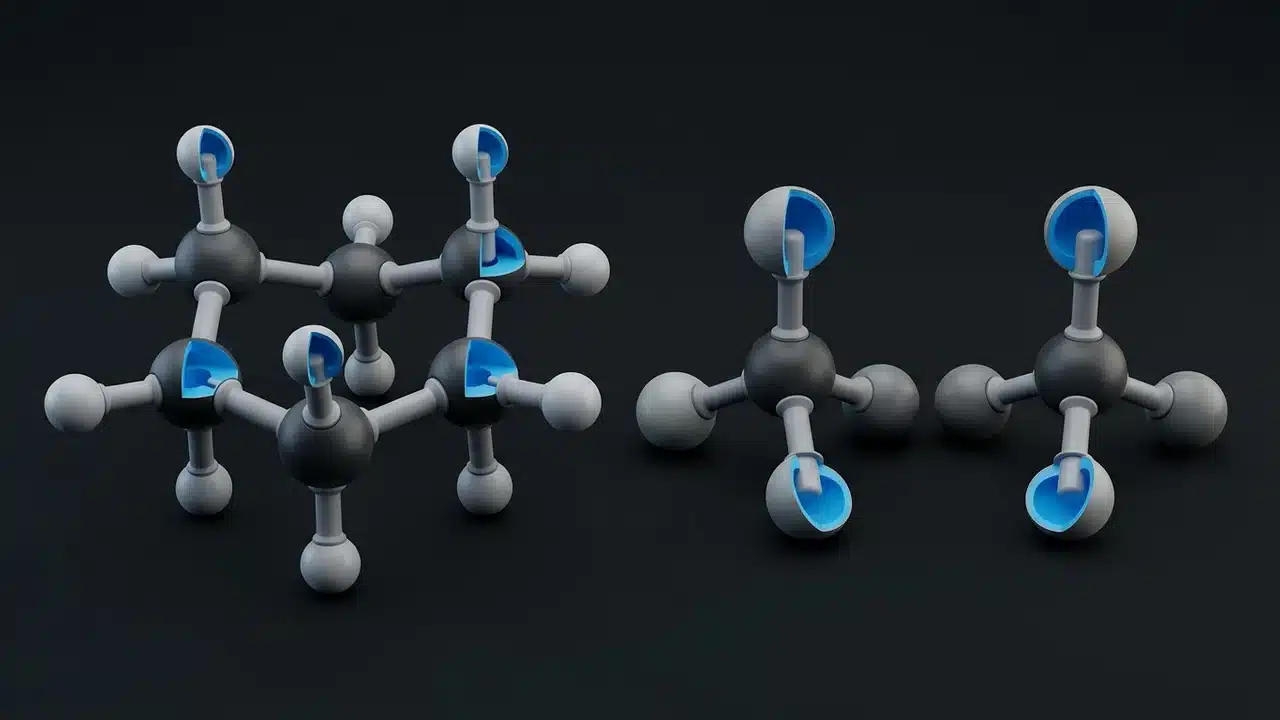
The syllabus is official: your orgo final is the ACS organic chemistry exam. Maybe your stomach dropped a little. You have a binder full of reactions, a model kit you used twice, and a few weeks left in the semester. Where do you even start? What is on the ACS organic chemistry exam, and how should you study for it?
The ACS organic chemistry exam is a standardized multiple-choice final that tests whether you can reason through organic structures and reactions, not just recall them. Most versions lean on the same core: structure and bonding, acids and bases, nomenclature, stereochemistry, substitution and elimination, addition reactions, and spectroscopy if your course covered it. Your professor picks the form and sets the time limit, so ask which one you’re getting. The best way to study is to learn the mechanisms behind each reaction, then practice timed, mixed questions for two to three weeks. A memorized reaction chart alone rarely survives a question that twists a familiar reaction.
What Is the ACS Organic Chemistry Exam?
It’s a nationally normed final written by committees of chemistry educators through the ACS Exams Institute. Your school buys it, and your instructor decides how to use it. Some count it as the whole final. Others blend it with their own questions or curve it against national norms.


There isn’t just one version. The Institute publishes organic exams for different points in the course sequence, and new forms come out over time. Some schools give a first-semester form at the end of Orgo 1. Others wait and give a full-year exam at the end of Orgo 2. Length and time limits vary by form, so don’t trust a number you read on a forum. Ask your professor. That one email saves a lot of guessing.
One thing is consistent: it’s multiple choice. You won’t get partial credit for a nice drawing. You get the bubble right or you don’t. That changes how you should study, and we’ll get to that.
Which Topics Show Up Most?
The exact mix depends on the form, but these topic areas show up again and again on organic finals built in the ACS style. Use this list as a checklist against your own syllabus.
- Structure and bonding. Lewis structures, formal charge, hybridization (sp, sp2, sp3), bond angles, resonance and which resonance form contributes most.
- Acids and bases. Ranking acidity using atom, resonance, induction and orbital (ARIO or a similar rule). Using pKa values to predict which way an equilibrium lies.
- Nomenclature. IUPAC names for alkanes, alkenes, alkyl halides and alcohols, plus E/Z and cis/trans.
- Conformations. Newman projections, chair conformations of cyclohexane, axial versus equatorial and which chair is more stable.
- Stereochemistry. Chirality centers, R/S assignments, enantiomers versus diastereomers, meso compounds and optical activity.
- Substitution and elimination. SN1, SN2, E1 and E2: which one wins, what the product looks like, and what happens to stereochemistry.
- Addition to alkenes and alkynes. Markovnikov versus anti-Markovnikov, syn versus anti addition, carbocation rearrangements.
- Spectroscopy. IR peaks (a strong C=O stretch near 1,700 cm−1), NMR splitting and integration, and mass spec basics, if your course covered them.
Full-year forms add the Orgo 2 material: aromatic substitution, carbonyl chemistry, and synthesis questions that chain several reactions together. If your course is on a first-term form, focus on the list above.
How Are the Questions Built?
ACS-style organic questions rarely ask “What is the product of reaction X?” in the exact form you memorized. They give you a slightly different starting material, a different solvent, or a bulky base, and ask what changes.
Take a typical setup. You’re given 2-bromobutane and sodium ethoxide in ethanol, and asked for the major product. If you only memorized “alkyl halide plus nucleophile gives substitution,” you’ll pick the ether. That forms, but only as a minor product.
Walk it through instead:
- The carbon holding the bromine is secondary.
- Ethoxide is a strong base, not just a nucleophile.
- A secondary halide with a strong base favors E2.
- E2 follows Zaitsev’s rule with a small base, so the more substituted alkene wins: 2-butene, mostly the trans isomer.
Swap ethoxide for potassium tert-butoxide and the answer shifts again. That bulky base pulls the easier-to-reach hydrogen, so 1-butene becomes the major product. Same substrate, different base, different answer. ACS-style questions use this kind of change a lot because it separates understanding from memorizing.
The wrong answer choices are built from common mistakes. You’ll see the substitution product, the wrong alkene, the wrong stereochemistry. If you have a hole in your reasoning, there’s an answer choice waiting for it.
How Do You Handle Acid-Base and Stereo Questions?
Treat them as reasoning problems, not trivia. These two topics are where a lot of easy points hide, and they’re also where students lose points by rushing.
Acid-base: look at the conjugate base
Say a question asks which is more acidic, ethanol or acetic acid. Don’t try to remember a pKa table first. Pull the proton off each one and look at what’s left.
Ethoxide keeps its negative charge stuck on one oxygen. Acetate spreads its negative charge over two oxygens through resonance. A more stable conjugate base means a stronger acid. So acetic acid wins, and by a lot: its pKa is around 4.8, while ethanol’s is around 16. Once you get in the habit of asking “how stable is the conjugate base?”, most acidity rankings fall into place.
Stereochemistry: count, then check for symmetry
A molecule with n chirality centers can have at most 2n stereoisomers. The word “most” is the trap. Take 2,3-dibromobutane. It has two chirality centers, so you’d guess four stereoisomers. But one of those structures has an internal mirror plane, which makes it a meso compound. The real answer is three: a pair of enantiomers plus one meso form.
Questions like this show up because they test whether you check your first answer. Build the molecule with a model kit if you can’t see the mirror plane. After a few tries, you’ll spot it on paper.
Why Mechanisms Beat Memorization on the ACS Organic Chemistry Exam
Organic chemistry has hundreds of reactions, but only a handful of moves. A nucleophile attacks an electrophile. A leaving group leaves. A proton gets transferred. A carbocation forms and maybe rearranges. That’s most of Orgo 1.
When you know the moves, you can work out a reaction you’ve never seen. When you only know the chart, a single changed reagent leaves you stuck. Mechanisms are also how you predict stereochemistry. SN2 inverts the chirality center because the nucleophile attacks from the back side. Bromine adds anti across a double bond because of the bromonium ion. If you know why, you don’t have to memorize the result as a separate fact.
The arrows matter too. Arrows always start at electrons (a lone pair or a bond) and point to where those electrons go. The LibreTexts page on using curved arrows in polar mechanisms lays out the rules clearly. Read it once, then draw arrows for every reaction you study.
You still need some memorization. Reagents like BH3/THF followed by H2O2/NaOH have to be in your head. The trick is to attach each reagent to a mechanism instead of a list. If you want a full system for that, read our guide on how to memorize organic chemistry reactions with mechanisms first.
A Two-to-Three-Week Study Plan for Orgo
Three weeks is ideal. Two weeks works if you’re disciplined. Adjust the days to fit your schedule, but keep the order.
Week 1: Rebuild the foundation
- Take one timed practice set, cold, before you review anything. Mark every miss by topic.
- Spend the first three days on structure, acid/base and stereochemistry. These topics feed every reaction question, so weakness here spreads everywhere.
- Build or redo chair conformations and R/S assignments with a model kit. Do it physically. Rotating a real molecule beats staring at a wedge on paper.
- End the week with 20 mixed nomenclature and stereo questions from memory.
Week 2: Reactions and mechanisms
- Make one summary sheet per reaction family: substitution/elimination, alkene addition, alkyne reactions. Include reagents, mechanism, regiochemistry and stereochemistry.
- Each day, close your notes and redraw two mechanisms from scratch. Check them. Fix the arrows.
- Drill SN1/SN2/E1/E2 decisions until you can call them in under a minute. Substrate, nucleophile or base strength, solvent, temperature. Those four clues decide it.
- Work “predict the product” and “pick the reagent” problems. Mix the reaction types so you can’t guess from the chapter heading.
Week 3: Timed practice and repair
- Take a full-length timed practice exam early in the week, under real conditions. No notes, no phone.
- Review every miss and every lucky guess. Write one sentence on why the right answer is right.
- Spend two days on your three weakest topics. Then do another mixed set.
- Go light the last day or two. Skim your summary sheets, sleep, and stop adding new material.
Only have two weeks? Squash Week 1 into three or four days, but don’t skip the cold diagnostic. It tells you where your time should go.
Where to Find Good Practice Material
Your textbook’s end-of-chapter problems are a solid start, but they’re grouped by chapter, so you always know what reaction is coming. The exam doesn’t give you that hint. Mix problems from different chapters on purpose. For a side-by-side look at free and paid sources, see where to find an ACS practice exam.
The ACS Exams Institute sells its own study guide for organic chemistry, plus practice exams, on its student study materials page. Ask whether your library or chemistry department already has a copy before you buy.
If you’d like a full run-through modeled on the ACS final format, take our Org Chem 1 practice exam in one sitting, under your real time limit. It has a video solution for every question, so you can watch the reasoning on the ones you miss. (ChemExams isn’t affiliated with the American Chemical Society, and the questions are our own.)
Ready for the ACS Organic Chemistry Exam? Start Tonight
The ACS organic chemistry exam rewards students who understand why reactions happen. Learn the moves, draw the arrows, and test yourself under time pressure on mixed questions. Everything else on the exam builds on those three habits.
Here’s your first step. Tonight, take one short timed set of mixed orgo questions with your notes closed. Sort your misses by topic. Tomorrow, start Week 1 with the weakest one. Three weeks from now, you’ll walk into that exam room with a plan instead of a binder full of hope.