
You’ve heard the orgo stories from older friends and seen them on pre-med forums. Maybe you felt it yourself in the first week, when the professor drew a molecule as a zigzag line with no carbons labeled. Still, there’s a clear answer to how to pass organic chemistry, because orgo is a learnable skill, and thousands of students get through it every year. The catch is that the study habits that worked in gen chem often don’t carry over. What does passing orgo take when it feels like a whole new subject?
To pass organic chemistry, learn arrow pushing first, build molecules with a model kit, keep one-page reaction maps, and work practice problems every day instead of cramming before exams. Orgo is less about calculation and more about seeing how electrons move, so your first job is to get fluent in mechanisms. Once you can push arrows, most reactions become variations on a few basic moves. A model kit fixes the 3D problems (stereochemistry, chair conformations) that trip up so many students. Daily practice matters because orgo builds fast, and a week of falling behind can take a month to recover from.
What Study Habits Have to Change for Orgo?
The biggest change is that orgo is a pattern subject, not a plug-and-chug subject. In gen chem, you could often find the right equation, plug in numbers and get an answer. Orgo has very few equations. Instead, you look at a structure and predict what it will do.


That means you need to change how you study:
- Gen chem rewards knowing the formula. Orgo rewards knowing why a reaction happens.
- Gen chem problems are mostly numbers. Orgo problems are mostly drawings.
- Gen chem topics can feel separate. In orgo, every chapter leans on the ones before it.
Is organic chemistry hard? It’s hard in a different way. Many students who struggled with gen chem math do fine in orgo, and some gen chem stars hit a wall. The difference is usually the method, not the student.
Step 1: Learn Arrow Pushing Before Anything Else
Arrow pushing is the grammar of organic chemistry. If you get it right in the first few weeks, the rest of the course makes sense. If you skip it, every reaction looks like a random fact.
The rules are short. A curved arrow shows two electrons moving. It always starts at the electrons (a lone pair or a bond) and ends where they go (an atom or a new bond). Electrons flow from electron-rich spots (nucleophiles) to electron-poor spots (electrophiles). The LibreTexts section on using curved arrows in polar mechanisms walks through these rules with examples.
Try a classic one. Hydroxide (OH−) reacts with bromomethane (CH3Br):
- Draw one arrow from a lone pair on the oxygen of hydroxide to the carbon of CH3Br. That carbon is electron-poor because bromine pulls electron density away from it.
- Draw a second arrow from the C–Br bond to the bromine atom. The bromine leaves with both electrons as bromide (Br−).
- The products are methanol (CH3OH) and Br−. Check the charges: one negative charge on the left, one on the right. Balanced.
That’s an SN2 reaction, and it happens in one step. Draw it five times from memory this week. Then draw the same arrows for hydroxide with ethyl bromide. Same moves, new molecule.
Step 2: Get a Model Kit and Actually Use It
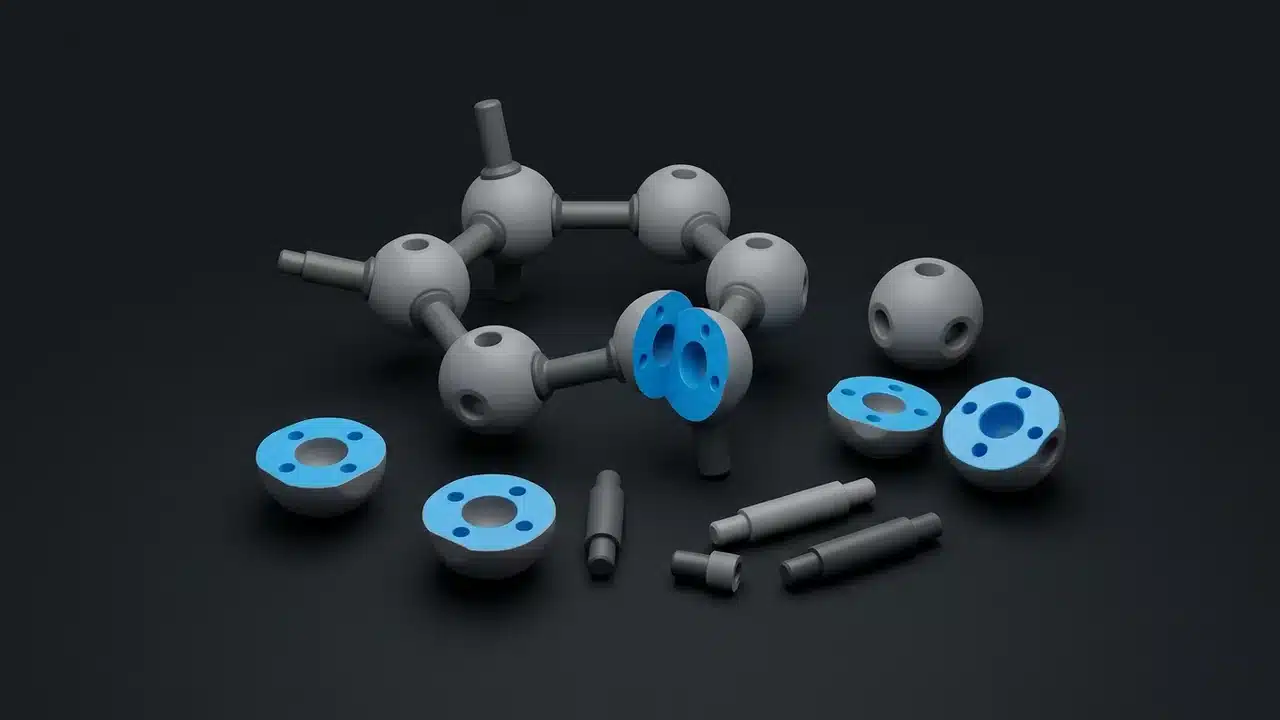
Buy a molecular model kit in the first week, and keep it on your desk where you’ll see it. Stereochemistry and conformations are 3D topics, and paper drawings hide the third dimension.
Use your kit for these:
- R and S. Build the molecule, point the lowest-priority group away from you, and trace the other three. You’ll see the answer instead of guessing.
- Chair conformations. Build cyclohexane, flip the chair, and watch axial groups become equatorial. Once you’ve done it by hand, the drawings make sense.
- Enantiomers and meso compounds. Build a molecule and its mirror image. Try to stack them. If they match, they’re the same compound.
- Newman projections. Look down a carbon-carbon bond of a real model, then draw what you see.
Some professors allow model kits on exams and many don’t, so check your syllabus. Either way, using a kit while you study trains your brain to picture molecules in 3D. After a few weeks, you won’t need it as much.
Step 3: Build One-Page Reaction Maps
As soon as you’ve learned a group of reactions, put them on a single page. For each reaction, write the starting material, reagents, product, mechanism type, and any regiochemistry or stereochemistry rules.
A typical alkene page might include:
| Reagent | What adds | Regiochemistry | Stereochemistry |
|---|---|---|---|
| HBr | H and Br | Markovnikov | Not controlled (carbocation) |
| HBr, peroxides | H and Br | Anti-Markovnikov | Not controlled (radical) |
| Br2 | Br and Br | Not applicable | Anti addition |
| BH3/THF, then H2O2, NaOH | H and OH | Anti-Markovnikov | Syn addition |
| H2, Pd/C | H and H | Not applicable | Syn addition |
Make these maps yourself. A printed chart from the internet won’t stick like one you wrote. Then, once a week, try to rebuild a map from a blank page. Whatever you leave out is what you study next.
Later in the course, connect the pages. Draw arrows from alkenes to alcohols to alkyl halides and back. These connections are exactly what synthesis questions test. For more on getting reactions to stay in your head, see our guide on how to memorize organic chemistry reactions using mechanisms first.
Step 4: Lock Down Acid-Base and Resonance Early
Acid-base chemistry and resonance are the two topics that quietly decide most of Orgo 1. Learn them well in the first month, and later reactions get much easier to predict.
Why? Almost every mechanism has a proton transfer or a charged intermediate somewhere in it. To know which way a reaction goes, you need to know which species is the stronger acid or base and how stable each charged piece is. Resonance is often the answer to “how stable.”
Try this check. Which is the stronger acid, cyclohexanol or phenol? Both have an O–H group. Remove the proton from each. Cyclohexanol’s conjugate base keeps its negative charge on one oxygen. Phenoxide can spread that charge into the benzene ring by resonance, which makes it more stable. More stable conjugate base, stronger acid. Phenol wins, with a pKa around 10 compared with roughly 16 to 18 for a typical alcohol like cyclohexanol.
If that reasoning feels shaky, spend an extra few days here before moving on. It’s the best investment you can make in the course.
Step 5: Practice Every Day, Even for 30 Minutes
Daily practice is the habit that separates students who pass orgo from those who scramble. Do problems every day, even short sets. Thirty focused minutes beats a four-hour Sunday.
A simple daily routine looks like this:
- 5 minutes: Redraw one mechanism from memory.
- 20 minutes: Work problems from the latest lecture, notes closed.
- 5 minutes: Do two problems from an older chapter, so nothing gets rusty.
Do the end-of-chapter problems from your textbook. If you need more, the free OpenStax Organic Chemistry textbook has extra problems by topic. Always attempt the full problem before checking the answer. Peeking after every step teaches you to recognize answers, not produce them.
How Many Hours a Week Does Orgo Take?
Plan on studying orgo most days of the week, not in one or two long blocks. A common rule of thumb for college science courses is 2 to 3 hours outside class for every credit hour, but your number depends on your background, your professor and how quickly the patterns click.
A better way to measure your effort is by output. Can you redraw this week’s mechanisms from memory? Can you name the reagents for each reaction on your map? Can you do last week’s problems without notes? If the answer is yes, you’re putting in enough time. If it’s no, add more practice, not more reading.
Where Should You Get Help in Orgo?
Get help early and get it specific. Office hours, TAs, campus tutoring and study groups all work, as long as you bring a problem you’ve already attempted.
For orgo, bring your drawing. Show the professor or TA your arrows and ask, “Where did this go wrong?” That one question gets you more than a fresh explanation of the whole chapter, because it targets the exact step you misunderstand.
Study groups work well for orgo if everyone draws on a whiteboard and takes turns. One person pushes the arrows out loud while the others check. You’ll catch mistakes in each other’s mechanisms that you would never spot in your own.
How to Pass Organic Chemistry Exams
Orgo exams reward fast, accurate pattern recognition. Start preparing in the last week before each midterm and about three weeks before the final.
For each midterm
- 7 days out: Rebuild every reaction map for the exam from memory. Note what you missed.
- 5 days out: Work mixed “predict the product” and “propose a reagent” problems. Shuffle chapters so you can’t tell which reaction is coming.
- 3 days out: Take an old exam or a practice set under a timer.
- 1 day out: Review your mistakes and redraw the mechanisms you missed. Then stop and sleep.
For the final
The final is cumulative, and at many schools it’s a standardized ACS exam. If yours is, read our guide to the ACS organic chemistry exam for the usual topics and a two-to-three-week plan.
Timed, mixed practice matters most in those last weeks. Set a timer and take our Org Chem 1 practice exam in one sitting for a full run in the ACS final format before the one that counts. (ChemExams isn’t affiliated with the American Chemical Society, and the questions are our own.)
What Mistakes Make Students Fail Orgo?
Most students who fail orgo make the same few mistakes. Not one of them is about intelligence.
- Memorizing without mechanisms. This works for a few chapters, then collapses when the reaction count climbs.
- Skipping stereochemistry. Students leave R/S and chair flips for later. Later never comes, and those questions show up on every exam.
- Studying by reading. Orgo is learned with a pencil. If you aren’t drawing, you aren’t studying.
- Falling behind in the first month. The first chapters (bonding, acid-base, resonance) support everything else. Weak foundations crack later.
- Waiting to get help. Go to office hours after the first quiz you struggle on, not after the second exam.
How to Pass Organic Chemistry: Arrows First, Everything Else After
Here’s the plan in one breath: push arrows until it’s automatic, build molecules with a kit, keep one-page reaction maps, practice a little every day, and prep for exams with mixed, timed problems.
You don’t need to be a genius for any of this. It requires showing up with a pencil most days and being clear with yourself about what you can’t draw yet. Students who pass orgo aren’t the ones who never get confused. They’re the ones who find the confusion early, while there’s still time to fix it.
Your first move is small: draw the hydroxide and bromomethane mechanism from memory, then check every arrow and every charge against your notes. When that one feels automatic, swap in a new molecule. Orgo rewards that kind of repetition far more than it rewards long, rare study sessions.