
Maybe you took chemistry in high school and did fine. Maybe you’re transferring in and haven’t touched a periodic table in years. Either way, your schedule now says “CHEM 101” or something like it, and you’ve heard enough rumors to be a little nervous. Is it the same class with a bigger room? Or something else entirely? What is college chemistry like, really?
College chemistry covers a lot of the same ideas as high school chemistry, but it moves faster, goes deeper into the math, and expects you to do most of the learning on your own time. You’ll usually have a large lecture, a separate lab with formal reports, and often a smaller recitation or discussion section. Homework is typically done on an online system that grades you instantly. Instead of lots of small tests, your grade often rides on a few midterms and a cumulative final, and at many schools that final is a standardized exam. The details vary by school and professor, so check your syllabus on day one.
How Is College Chemistry Different From High School?
The short version: less hand-holding, more independence, higher stakes per exam. Here’s a side-by-side look. Your school might not match every row, but this is the general pattern most students run into.


| Part of the class | High school chemistry | College chemistry |
|---|---|---|
| Class size | Usually 20 to 35 students | Often a lecture hall with a hundred or more |
| Pace | A chapter can take weeks | Often a chapter every week or so |
| Homework | Worksheets, checked in class | Online system with deadlines and instant grading |
| Lab | Part of class time, short write-ups | Separate session with pre-labs and formal reports |
| Exams | Frequent quizzes and unit tests | A few midterms plus a cumulative final |
| Help | Teacher sees you every day | You go to office hours, tutoring or recitation |
| Who checks on you | Teachers and parents | Mostly you |
That last row is the big one. Nobody is going to chase you down for a missed homework set. The system just records a zero and moves on.
What Is College Chemistry Like in a Big Lecture?
It’s a lot like watching a really fast documentary that you’ll be tested on. The professor stands at the front, works through slides or writes on a board, and covers a big chunk of material in an hour or so. You might have clicker questions or an app that polls the class. You probably won’t get called on.
Lecture is where you get introduced to the material, not where you learn it. You learn it later, at your desk, when you try problems and fail and try again. Students who treat lecture as the whole class tend to get blindsided by the first exam.
A few tips that make lecture more useful:
- Skim the section before class, even for ten minutes. Lecture makes way more sense when the words aren’t brand new.
- Sit where you can actually see the board. The back row is cozy and terrible.
- Write down the problems the professor works. Those are hints about what shows up on exams.
What Are College Chemistry Labs Like?
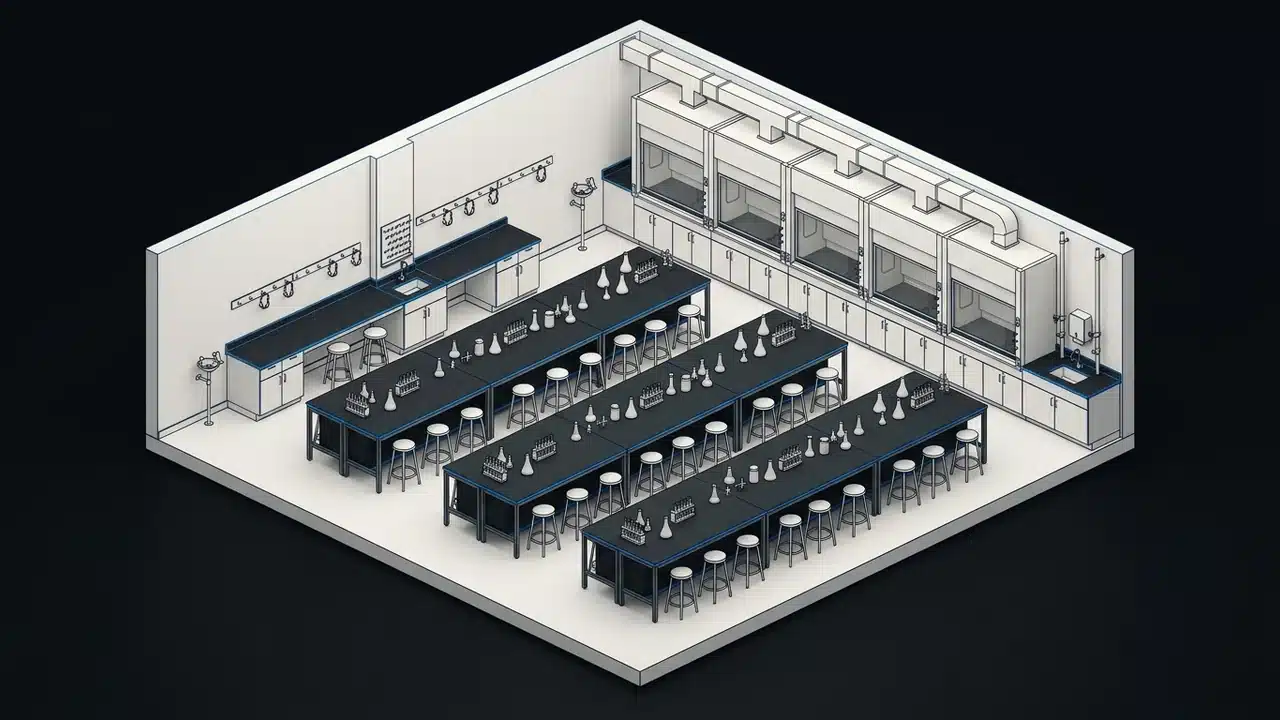
College labs are usually a separate block of time, often two to three hours, with their own teaching assistant and their own grade. Before you walk in, you may have to finish a pre-lab assignment or quiz. If you don’t, some labs won’t let you start. Read the procedure ahead of time so you’re not the person squinting at step 4 while your partner does everything.
Afterward, you’ll write lab reports. Depending on your school, that might be a worksheet or a full report with data tables, calculations, error analysis and a discussion. Lab reports take longer than people expect. Budget real time for them, not the 40 minutes before the deadline.
What Is Recitation, and Do You Have to Go?
Recitation (some schools call it discussion section) is a smaller class, usually run by a teaching assistant, where you work problems and ask questions. It’s the closest thing to a high school class you’ll get in college chemistry. Some schools take attendance or give quizzes there. Others don’t.
Go anyway. Recitation is free practice with someone who knows the answers and isn’t intimidating. Bring your questions from the homework. The TA would much rather answer a real question than watch 25 people stare at their phones.
How Does Online Chemistry Homework Work?
Most college chemistry classes use an online homework platform. Common ones include ALEKS, Mastering Chemistry, Sapling and similar systems, but your school picks which one. You type in an answer, and the system tells you right away if it’s right. Many give you a limited number of tries before you lose credit.
This sounds convenient, and it is, but it has a trap. It’s easy to guess, peek at hints and click through until it turns green. You get the points, but you don’t get the skill. Then the exam shows up with no hints and no retries. Try each problem on paper first, as if it were an exam question, and use the system to check your work.
What Are College Chemistry Exams Like?
They’re bigger, fewer and worth more. Many classes have two to four midterms and a cumulative final, so a single bad day can move your grade a lot. Exams are often multiple choice in large classes because someone has to grade hundreds of them, though some professors include written problems.
At many schools, the final is a standardized exam written by committees of chemistry educators through the ACS Exams Institute. Most ACS exams are multiple choice, but the length and time limit depend on the exam and on what your professor or department chooses, so ask your instructor which version you’ll take. The questions mix concepts from the whole term, which is why cramming the last chapter doesn’t cut it.
If your class ends with an ACS-style final, our Gen Chem 1 practice exam is modeled on that format. It’s most useful in the last few weeks of the term, so the multiple-choice style won’t be brand new on test day.
How Much Time Does College Chemistry Take Each Week?
More than you’d guess from the number of hours on your schedule. Between lecture, lab, recitation, homework, lab reports and reviewing for exams, chemistry can easily become the class that eats your week. Many colleges suggest 2 to 3 hours of study outside class for every credit hour, and chemistry is a class where that advice holds up.
The bigger change is the pace. In college, the class doesn’t slow down because half the room is confused. If you fall behind in week 3, week 4 builds on week 3, and now you’re behind twice. Little and often beats one huge Sunday session. An hour or so most days, plus longer blocks before exams, keeps you caught up without taking over your life.
Why Does College Chemistry Feel Harder Than High School?
Mostly because of the pace, the math and the independence, not because the ideas are impossible. Most students feel that jump at first. For the full answer to is general chemistry hard, plus what to do about it, see our separate article.
And the students who do well usually aren’t geniuses. They show up, keep up with homework, ask for help early and practice problems instead of rereading notes. Those are habits, not talents.
Your First Week, Survival Edition
So what is college chemistry like? It’s faster, more math-heavy and more on you than high school chemistry was. You get a big lecture, a separate lab with real reports, usually a recitation, an online homework system and a few high-stakes exams, sometimes ending in a standardized final.
That doesn’t mean you’re doomed. It means you need a system. In your first week, read the syllabus all the way through, put every exam date in your calendar, find your professor’s office hours and figure out where tutoring happens on campus. Then do the first homework set early, on paper, before you need to.
You’ll probably have at least one night where chemistry makes you want to throw your laptop. Totally normal. Close it, sleep and try again tomorrow. That’s most of the secret.